
Environmental health permitting and inspection software

PH360 Spruce: environmental health, permit to inspection.

One place for the whole permit. The business owner applies, uploads, and pays without calling you. The health agent opens a review file that is already prepared. The inspector arrives briefed and works offline. Spruce drafts the groundwork at every step, and a person makes the call.

Configured to your code, forms, and fees Office, field, and offline A person confirms every AI action

Local public health

Environmental health has never had a system of its own.

You permit restaurants, pools, septic, and housing. You inspect them on a schedule set by risk, you cite against a code your jurisdiction adopted and amended, and you carry the enforcement that follows. The tools on offer are generic permitting platforms that know nothing about a food code, so the knowledge lives in binders and in the inspector who has been there twenty years. We started from that inspector instead.

The operating idea

The inspector makes the call. Spruce does the paperwork around it.

Grounded, or it abstains

Spruce works from your adopted code and your own records, not the open web. With no grounded source it says so instead of guessing.

Deterministic where it must be

Fees, deadlines, and inspection frequencies are computed by rule, not inferred. The same inputs give the same answer every time.

The human owns the consequence

A citation goes on the record when the inspector cites it. A permit issues when the agent approves it. Every action carries a name and a rationale.

Your jurisdiction's own form

Categories, required documents, fees, priority levels, and correction deadlines are settings, not code changes. Nobody files a ticket with us.

One permit, end to end

See Spruce in action.

One food service permit, in the order it happens. A new restaurant applies and pays, the health agent opens a review file that is already prepared and decides, the inspector visits and cites, the permit issues, and a year later it renews. Anything in purple is drafted by AI and waits on a person.

Scope

What Spruce covers.

Applications the public can finish

A portal where owners apply, upload, and pay, with the required fields and documents following from their own answers. The review file is prepared for your staff the moment it is submitted.

By role

What changes, and for whom.

The field inspector

Arrives briefed instead of blind, logs the visit offline, and confirms a drafted finding with the code section already attached rather than writing it up back at the office.

The health agent

Opens a review file that is already prepared, sees which documents disagree with the application before reading them, and spends the time on the decision instead of assembling the packet.

Department leadership

Changes categories, fees, and deadlines by configuration instead of a change request, and can answer a records request from a trail that records who did what and why.

The business owner

Applies, uploads, and pays without a phone call, sees where the application stands at any hour, and renews from last year instead of starting over.

Part of the platform

Spruce runs on the same engine as the rest of PH360.

Spruce runs on our public health reasoning engine, the same one behind the rest of PH360. The FDA Food Code is built in, and your own adopted rules, forms, and fee schedule sit alongside it. That is also why you change your own categories, documents, and deadlines instead of filing a change request with us.

Common questions

Spruce FAQ.

How do we get started?

We configure Spruce with you: your establishment categories, required documents, fee schedule, inspection frequencies, priority levels, and correction deadlines, plus the forms and certificates your jurisdiction issues. Schedule a walkthrough and we will scope it against your own permits.

Does it work with the code we actually adopted?

Yes, and that is the point. The FDA Food Code is built in, and your local adoption and amendments sit alongside it. Findings are drafted against what your jurisdiction enforces, with the section and the source shown so the inspector can verify it before citing.

What happens in the field with no signal?

The inspector keeps working. The establishment history, prior citations, and the checklist are stored on the device, and the visit syncs when there is a connection again. How long a device may stay offline before it must sync is a setting you control.

How do we know an AI-drafted citation is right?

You check it, and Spruce is built to make that quick. Every drafted finding shows the code section, the source it came from, a confidence level, and the code text in plain language. It only proposes findings it has a grounded source for, and when it does not it abstains rather than guessing.

Is there a human in the loop on the AI?

Always. Anything AI-generated is marked in purple and cannot complete on its own. The agent accepts or changes the proposed day plan, AI-drafted findings must be marked reviewed, the inspector is the one who cites, and returning or denying an application requires a rationale recorded under a name.

What happens to our current permitting system?

Most departments start with one permit type in Spruce and leave the rest where it is until they are ready. Single sign-on, directory integration, and access to your data through an API get settled in that scoping conversation, and we will tell you plainly what is in place and what we would build.

Are those real records in the screenshots?

No. Every screen is the actual product, and the people, businesses, and permits in them are sample data. Nothing on this page came out of a live department.

See it against your own permits.

Thirty minutes. Bring your establishment categories, your fee schedule, and the code you adopted, and we will run Spruce against them.

Download the Spruce overview (PDF)

By Public Health, For Public Health

DM³: Public Health Data Modernization Maturity Model

Know where you are. Build a path forward. DM³ scores your department across six domains — governance, data life cycle, leadership, partnerships, equity & power, and sustainability — on a 10-level scale, then turns that score into a roadmap you can actually staff and fund. Woman-owned. 8(a) certified.

Schedule a DM³ Assessment
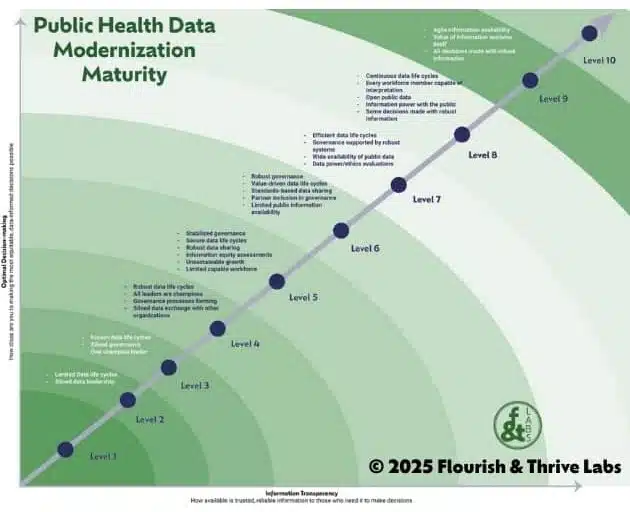
DM3 maturity model chart showing Levels 1 through 10 plotted against optimal decision-making and information transparency, from limited data life cycles at Level 1 to agile, trusted information availability at Level 10.

Want to learn more about the DM³ framework?

The Framework

Six Domains of Data Maturity

DM3 evaluates your department across six key domains. For each, we assess your current maturity level (1-5) and identify specific, achievable steps to advance.

DM3 wheel diagram showing the six domains of the Data Modernization Maturity Model arranged around a lightbulb: Governance, Data Life Cycle, Leadership, Partnerships, Equity and Power, and Sustainability Practices.
  • 1

    Governance

    Policies, standards, and accountability structures that guide how data is managed.

  • 2

    Data Life Cycle

    How data moves from collection through storage, sharing, and use.

  • 3

    Leadership

    Strategic vision and executive sponsorship that connects data to organizational priorities.

  • 4

    Partnerships

    Relationships with external data contributors and partners that expand what your data can show.

  • 5

    Equity & Power

    Whether data collection and use represent all populations fairly, especially those historically marginalized.

  • 6

    Sustainability Practices

    Funding, staffing, and long-term planning that keep data modernization progress from stalling out.

The Process

How DM3 Works

1

Assessment

We interview stakeholders, review documentation, and evaluate your current state across all six domains.

2

Scoring & Analysis

You receive detailed scores with evidence-based justification and peer comparisons where available.

3

Roadmap Development

We create a prioritized improvement roadmap with realistic resource requirements and quick wins.

4

Implementation Support

Optional ongoing support to execute your roadmap, track progress, and adjust as needed.

Why Use DM3

Benefits of a Maturity Assessment

Objective Baseline

Know where you actually are, not where you think you are. Evidence-based assessment removes guesswork.

Prioritized Action

Focus limited resources on improvements that matter most. Not everything needs to be fixed at once.

Stakeholder Alignment

Give leadership and staff a shared vocabulary for discussing data needs and investments.

Grant Readiness

Demonstrate data maturity to funders with a defensible assessment. Support funding applications with evidence.

Frequently Asked Questions

Data Modernization Questions

What is public health data modernization?

Public health data modernization is the process of upgrading how health departments collect, manage, analyze, and share data. This includes improving data infrastructure (systems and tools), implementing data governance (policies and accountability), building analytics capacity, developing workforce skills, and creating a data-driven organizational culture. The goal is better, faster, more useful data for public health decision-making.

What is a data maturity model?

A data maturity model is a framework for assessing how well an organization manages and uses its data assets. It typically measures capabilities across multiple domains (like infrastructure, governance, and workforce) using defined maturity levels. DM³ uses a 5-level scale from "Initial" (ad-hoc, reactive) to "Optimizing" (continuous improvement, innovation). Maturity models help organizations understand their current state and prioritize improvements.

How is DM³ different from other maturity assessments?

DM³ was built specifically for public health. Generic data maturity models don't account for public health constraints: grant-funded operations, HIPAA requirements, community health mandates, and the unique relationship between data and population health outcomes. DM³ assesses the domains that matter most for health departments and produces recommendations that are realistic given typical public health resources and governance structures.

What does data interoperability mean for health departments?

Data interoperability is the ability for different systems to exchange and use data effectively. For health departments, this means surveillance systems can share data with EHRs, lab reporting flows into case management, and data can be exchanged with state and federal partners. DM³ assesses your current interoperability capabilities and helps identify practical steps toward better data exchange—whether through standards like FHIR or simpler integration approaches.

How long does a DM³ assessment take?

A typical DM³ assessment takes 4-6 weeks from kickoff to final report. This includes stakeholder interviews (usually 8-12 people), documentation review, scoring and analysis, and roadmap development. The process is designed to minimize burden on your staff—most interviews are 45-60 minutes, and we work around your schedule. Larger departments or those wanting deeper analysis may extend the timeline.

What do we get from a DM³ assessment?

You receive: (1) A detailed assessment report with maturity scores across all domains, evidence-based justification for each score, and comparison to peer benchmarks where available; (2) A prioritized improvement roadmap with specific, achievable recommendations, resource requirements, and suggested sequencing; (3) An executive summary suitable for leadership and board presentations. Optionally, we can provide ongoing implementation support.

How does DM³ relate to CDC's Data Modernization Initiative?

DM³ is aligned with CDC's Data Modernization Initiative goals: improving data quality, timeliness, and interoperability across public health. Our assessment covers the capabilities CDC emphasizes—data infrastructure, governance, workforce development, and partnerships. A DM³ assessment can help you demonstrate progress toward DMI goals, identify gaps, and prioritize investments. It's particularly useful for health departments preparing for DMI funding opportunities.

Ready to Assess Your Data Maturity?

Let's talk about where you are and where you want to be.

Schedule a DM³ Conversation →
Subscribe To Flourish Notes
Sign up to receive our monthly dose of public health analysis, joy, and favorite things.

Subscribe To Flourish Notes

Sign up to receive our monthly dose of public health analysis, joy, and favorite things.

Sign up to receive our monthly dose of public health analysis, joy, and favorite things.

You have Successfully Subscribed!